When the sun drops behind the Front Range, a Denver yard changes character. The foothills go gray, the air cools, and your landscape either fades into darkness or takes on a second life. Thoughtful, layered exterior lighting is what tips the balance. It builds depth and rhythm in a garden, keeps walkways honest on icy nights, and coaxes architecture into sight without shouting at the neighbors. In a city that sits at 5,280 feet with more than 300 sunny days a year and real winter, the way you compose those layers matters even more.
I have walked dozens of Denver properties in March when snow is still hiding in north corners, and in September when the light turns amber by dinner. The best outdoor lighting I see, whether it is a modest Wash Park bungalow or a hilltop home in Golden, uses layers the way a good musician uses melody, harmony, and rhythm. Each layer has a job. Together they make a place feel intentional and easy to live in.
What layering means in a Denver yard
Layered lighting builds from wide to narrow, from background to foreground. Think first of ambient light that sets the tone, then of task light that keeps steps and paths safe, then accents that guide the eye, and finally some selective sparkle that gives life. The Denver climate and terrain shape each decision. Altitude, snow reflectivity, dry air, and rapid temperature swings test fixtures and reveal bad glare instantly. Elevation means the night sky is clearer, so lights that spill upward do more damage to stars and neighbor relations. Plant palettes also shift lighting installations denver with seasons, so the layer that flatters an aspen’s fluttering leaves in July should not look harsh when that same trunk stands bare in January.
I keep an eye on four realities:
First, cold amplifies glare. Snow bounces light back, so what feels pleasantly bright in June may look like a stadium in December. Plan for dimming by season.
Second, UV and dry air wear plastics and gaskets faster at altitude. Stronger materials and better seals pay off.
Third, winds and freeze-thaw cycles loosen stakes and junctions. A clean install up front saves winter troubleshooting later.
Fourth, Denver neighborhoods and nearby foothill communities value dark-sky practices. Downlighting, warm color temperatures, and careful shielding help keep the peace.
The core layers, from wide to tight
Ambient, task, accent, and sparkle are the building blocks. People use different names, but the work is the same. Below is a compact map of common layer types with where they tend to shine on a Denver property.
- Ambient: soft, even light that sets mood across a space. Examples include wide wall washing on stucco or brick, soffit downlights on patios, and gentle tree-mounted downlights that create a moonlit feel on turf or hardscape. Task: focused light that helps you do something safely. Path lights along flagstone, step lights set into risers, and low-glare bollards at driveway edges keep feet and tires where they belong. Accent: punch and focus for features that matter. Narrow-beam uplights for blue spruce or hawthorn, grazing light up a rough stone column, or silhouette light behind ornamental grass gives structure to the scene. Sparkle: the smallest layer, used carefully. A subtle pendant over an outdoor table, a soft line of light under a bench, or a wet-rated micro-spot that kisses an aspen’s white bark. Sparkle should never take over.
Those categories are universal, but the choices inside them are local. Denver exterior lighting lives with snow and long summer evenings, so beam angles, color temperature, and positions shift.
Color temperature and the Front Range sky
Warm light reads best on Colorado landscapes most of the year. 2700 to 3000 Kelvin flatters flagstone, cedar fences, buff sandstone, and plant material. It also reduces blue light scatter that can wash a clear night sky. I hold 2700K as my default for denver yard lighting close to the house and across plantings. For tree-mounted downlights used for a moonlight effect, nudging up to 3000 or 3500K can break through foliage layers and read more like real moonlight without going clinical. If a client insists on cool light for a modern facade, I try 3000 to 3500K on the architectural surface and keep all landscape lighting denver warm so the grass and perennials do not turn icy.
Color consistency matters more than most people expect. Mixing wildly different lamps can make the yard look patchy. If you prefer tunable denver outdoor fixtures, set scenes for seasons. A fall scene that runs warmer balances longer nights, while a snow scene may cut total brightness and shift a notch cooler to carry contrast against the snowpack without glare.
Beam angles, outputs, and what looks natural
Layers are as much about restraint as power. Big lumen numbers only help if they are shaped and placed correctly. For denver garden lighting that uplights a serviceberry or small maple, a 10 to 25 degree spot at 300 to 500 lumens from 12 to 18 inches off the trunk gives a strong vertical without blowing out the crown. For larger ash or elm, 600 to 1200 lumens split across two or three fixtures reads better. I rarely exceed 1200 lumens per fixture in a residential setting unless I am shooting a very tall blue spruce, and when I do, I shield it carefully to avoid off-site spill.
Path lights do honest work at low levels. Most properties are happier with 100 to 200 lumens per fixture spaced 6 to 8 feet apart depending on plant mass. Overlight a path and it starts to look like a runway, especially with snow on the ground. Step lights embedded in risers are even gentler, often 50 to 100 lumens each, concealed so only the tread glows.
Wall washing on stucco or stone should be even and quiet. Linear fixtures or wide floods at 200 to 400 lumens per foot, set a few feet off the wall and aimed shallowly, bring out texture without hot spots. A graze that sits close to rough stone and aims steeply can run brighter because the shadows it creates break up intensity.
Moonlighting and how trees change the scene
Downlighting from within trees, often called moonlighting, gives Denver’s outdoor lighting a natural, restful base layer. I prefer hardwoods with sturdy crotches like honeylocust or oak to support fixtures, mounted with arborist-approved straps to avoid damaging bark. A pair of 300 to 500 lumen, 30 degree spots mounted 15 to 25 feet up create overlapping pools of light that move with leaves. In winter when branches are bare, the pattern grows more crisp, so dimming becomes essential. In neighborhoods like Park Hill or South City Park with tall mature canopies, moonlighting can carry an entire yard with only a handful of fixtures.
Mounting height and distance to target matter. A downlight too close to the ground makes a harsh, narrow pool. Too high and you risk glare to second-story windows. Elevated fixtures collect snow less than ground lights and release heat better, but they do require annual checks after storms. Use warm color temperatures to keep the effect from going cold on snow, and keep lens glass clean to avoid sparkle turning into scatter.
Pathways, steps, and the icy week of January
Denver pathway lighting should serve the body, not the camera. A path test at night with a mug of tea in one hand tells you quickly where pools and shadows fall. On curved flagstone, stagger fixtures on the inside and outside of curves to avoid scalloping. On straight segments, I bias lights to the planting side, not the turf edge, to hide glare. For steps facing west, where afternoon melt refreezes overnight, a riser-integrated light does more to reveal ice than a post-mounted path light ever will.
Even small details help in winter. Shielding or louvering path fixtures reduces reflection off snow. If you expect heavy shoveling, move lights back an extra foot from hardscape edges to survive a rough January. Where snow drift is common, a slightly taller bollard with a controlled beam can punch above drift height without looking industrial if the finish and scale are right.
Architecture and materials: stucco, brick, timber, and steel
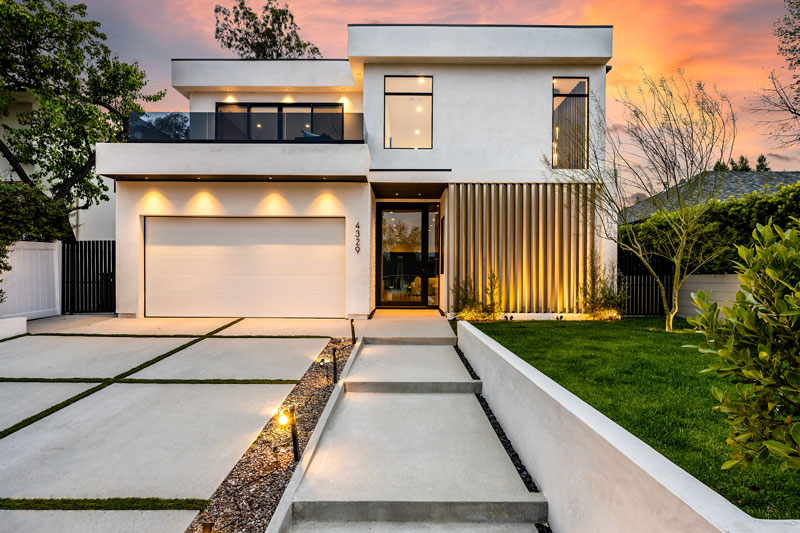
Denver mixes architectural styles. A 1920s brick Tudor lives two doors down from a contemporary box with steel and cedar. Exterior lighting denver needs to read the facade honestly. Brick takes grazing light beautifully. Mount a narrow flood a few inches off the surface and the mortar joints pick up gentle shadow that adds warmth. Stucco prefers wash light from a few feet back to smooth out texture. Horizontal cedar looks best with long, low beams that pull across grain. Steel and board-formed concrete risk glare. Keep their light level lower than the living material around them to avoid a cold front.
When a facade already has bright sconces at the front door, treat them as part of the ambient layer and trim new fixtures accordingly. If the sconces use bright, cool lamps, consider swapping them for 2700K dimmable LEDs with frosted glass to soften entry views. It is amazing how often the best denver exterior lighting move is to fix what is already there.
Controls, zoning, and scenes you will actually use
Smart control promises a lot yet many people end up with one on or off button. The trick is to zone your denver lighting solutions along true use patterns. Separate architectural lighting, trees, paths, and water features into at least three zones. Put moonlights on a dimmer channel by themselves. Set astronomical timers so lights come on at sunset and off at different times for weeknights and weekends. I like a late-night mode that drops the property to one third brightness and turns off accent layers entirely, keeping only safety lighting. It lowers energy use and keeps the neighborhood quieter.
If you prefer app-based systems, keep scenes simple. A dinner scene, an everyday scene, and a snow scene cover most lives. If you work with a pro offering outdoor lighting services denver, ask for physical documentation that lists transformer locations, breaker numbers, and scene settings. It saves time later.
Power and infrastructure you do not see but feel
Most residential colorado outdoor lighting runs on 12-volt low-voltage systems. Transformers sit near power sources, often in garages or on exterior walls. When we size transformers, we leave 20 to 30 percent headroom for future growth and cooler operation. Long wire runs to the back fence need heavier gauge cable or multiple home runs to keep voltage near target at each fixture. Voltage drop shows up as uneven brightness and short lamp life. At altitude and in cold, LED drivers are happier when they are not pushed to their limit. Good denver lighting solutions start behind the scenes.
Cable burial depth follows code, but in practice I see 4 to 6 inches with GFCI protection and conduit under driveways or walkways. I avoid direct splices in planting beds that get heavy irrigation or regular digging. Wherever a path crosses a root zone of a prized tree, I sleeve the cable and place it shallowly to keep roots happy. Winter heave can pull fixtures up over a couple of seasons, so leave a little slack at terminations and plan a spring reset.
Hardware that survives high plains weather
At 5,280 feet, UV is harder on finishes and seals. Cheap powder coat on aluminum chalks quickly. Brass and copper age well and match Denver’s dry climate visually. Stainless steel fares better than aluminum on bollards that see shovels and gravel. For wet areas and irrigation overspray, go for IP65 or higher. Lens design matters too. Convex lenses shed water and snow more than flat ones. Gaskets and set screws should look like someone cared.
I have pulled too many failed fixtures that were beautiful the day they were unboxed but not six months later. Spend your money on optics, materials, and seals before you spend it on app features. With denver outdoor lights, quality shows up in year two when everything still works after a February thaw and freeze.
Light pollution, neighbors, and the pleasure of a dark sky
You cannot talk about outdoor lighting in Denver without talking about the sky. The Front Range has some of the clearest nights in the country, and light that shoots up or sideways wastes power, flattens the Milky Way, and irritates the people next door. Shielded fixtures, modest outputs, and warm color help. Aim beams only where needed. If you can see the lamp from anywhere you plan to sit, you will feel it in your eyes all night.
Many municipalities along the corridor encourage dark-sky principles, and some HOAs have strict guidelines. Before a large installation, check neighborhood rules and any local notes on lumen caps or curfews. Even if rules are loose, set your own. Keep denver outdoor illumination on paths, steps, doors, and key accents, and let the rest of the yard fade gently. It is striking how much more luxurious a property feels when not every tree is lit.
Plant-specific notes from local yards
Aspen bark glows with very modest uplight. One 300 lumen spot with a 25 degree beam is often enough. Overpower it and you lose the delicate striation.
Blue spruce reflect light with a cool cast. Warm lamps keep them from turning steely. Use narrow beams to reach into the canopy, two fixtures 90 degrees apart for anything over 20 feet.
Ornamental grasses like Karl Foerster and Miscanthus become lanterns in October. A low grazing beam from behind turns seed heads into gold. In winter, that same backlight through snow is one of the most satisfying scenes in denver landscape lighting.
Flagstone reads unevenly if lit from a single side. Cross-lighting at low levels fills shadows without flattening texture. light fixtures Keep it soft, with fixtures pulled back into plant mass.
Water features win with restraint. You do not have to see the source of the light, just the movement. Submersible warm-white points set to graze the ripple of a boulder outflow quietly beat the blue glow that screams mall fountain.
A practical flow for planning a layered system
- Walk the property after dark without lights, then with a temporary work light. Note how your eyes adapt and what you actually need to see. Make a short list of must-have tasks and a second of moments that deserve emphasis. Sketch zones tied to how you live. Entry, side yard trash run, dog loop, dining area, fire pit, vegetable bed. Decide which ones need daily light and which only on occasion. Choose color temperatures by surface. Warm for plantings and stone, slightly warmer or equal for siding, and keep cool whites out of the garden unless you have a hard modern palette and accept the trade-off. Specify outputs and beam angles per target, not per fixture. Work backward from height, distance, and surface reflectivity. Split large targets into multiple lower-output beams rather than blasting with one. Test and tune. Install dimmers. Spend at least two nights walking and adjusting aim, brightness, and shield positions. Write down final settings for every zone.
A single evening of testing saves years of living with odd shadows or glare. If you engage professionals in outdoor lighting installations denver, ask for a temporary mockup before trenching. Even a handful of loaner fixtures with alligator clips and a portable transformer can show you 80 percent of the final effect.
Examples from local projects
A Craftsman bungalow near South Pearl had a lovely elm arching over the sidewalk and a patched-together set of coach lights. We replaced the coach lamps with shielded, warm sconces at half the original output and mounted two small downlights in the elm at 18 feet. Path lights dropped to every other bay once the downlights softly washed the walk. The front porch glowed quietly, and the entire facade felt taller without a single uplight on brick.
In the foothills outside Golden, a slope fell away from the deck. Traditional uplights on the pines looked theatrical and made the night sky feel smaller. We pulled the uplights, mounted three fixtures high in two trees to moonlight the slope, and added under-rail task lights on the deck steps. A single 1.5 watt micro-spot warmed a boulder by the hot tub. The stars came back, and the deck finally felt connected to the hillside.
A modern row home in Central Park had a narrow courtyard with a steel screen and planters of switchgrass. Instead of top-lit bollards, we used low side-mounted grazers on the steel to draw soft lines and tucked two backlights behind the grasses to silhouette them at night. The tiny space grew depth instantly, and the neighbors no longer saw glare through their windows.
Safety, code, and service notes that matter later
Local code evolves, and every property carries quirks, but a few habits rarely fail. Keep GFCI protection on exterior circuits. Mount transformers out of splash zones with space for ventilation. Label every run in the transformer cabinet. Place splice points where you can reach them without digging, inside junction boxes where appropriate. If you run lighting near water, verify fixture and connection ratings, not just the marketing tagline.
Service is not glamorous, yet it determines how you feel about a system in year three. A twice-yearly walk is enough for most denver outdoor lighting systems. Spring: reset fixtures heaved by frost, trim plants around beams, rinse lenses, check transformer voltage under load, reprogram timers for daylight shift. Fall: aim for the now-bare branches, dim bright paths in anticipation of snow reflectance, check that snow shoveling will not shear a path light. The simplest maintenance routine prevents most calls.
Budgeting and when to phase
People often ask what a layered plan costs. Ranges vary with materials, access, and whether power already exists. A modest front yard with eight to twelve fixtures, a single transformer, and clean trenching can land in the low thousands with quality components. A full yard with moonlighting, path work, architectural washing, and smart controls easily climbs into the tens of thousands. If that feels steep, phase the work. Start with safety and ambient layers, then add accents and sparkle as you live with the space. Good outdoor lighting solutions denver adapt to how you use your home, not the other way around.
Working with pros or doing it yourself
If you are handy and enjoy tinkering, low-voltage outdoor lighting denver is achievable with patience. Invest in good wire strippers, heat-shrink connectors, and a basic multimeter. Set aside evenings to test aims. For larger systems or if you want clean integration with existing electrical and controls, call someone who lives and breathes landscape lighting denver. Reputable firms that focus on lighting installations denver will walk you through beam angles, voltage drop, transformer sizing, and dark-sky practices. Whether you hire out or go DIY, the quality of design choices matters more than whether a system is branded.
Bringing it all together
Layered lighting is not a style, it is a way to think. Start wide with gentle ambient tones that suit the Denver climate and architecture, take care of the jobs that keep feet safe and faces visible, then add carefully chosen accents that guide the eye. Save sparkle for last. Use warm color temperatures, shield light, and respect the night sky. Choose materials that survive UV, snow, and swings in temperature. Zone your system in a way your brain will use daily, and leave room to tune.
When it all clicks, denver outdoor lighting feels quiet and sure. You notice the dog finds his path without hesitation, the grill area works on a December evening, and the spruce outside the living room becomes a companion rather than a black mass. That is the point. Not brighter, not more gadgets, just a yard that lives as well by evening as it does by day. If you keep that aim clear, the layers practically arrange themselves. And the city lights remain where they belong, beyond your fence, with the sky still deep and generous above.
Braga Outdoor Lighting
18172 E Arizona Ave UNIT B, Aurora, CO 80017
1.888.638.8937
https://bragaoutdoorlighting.com/